
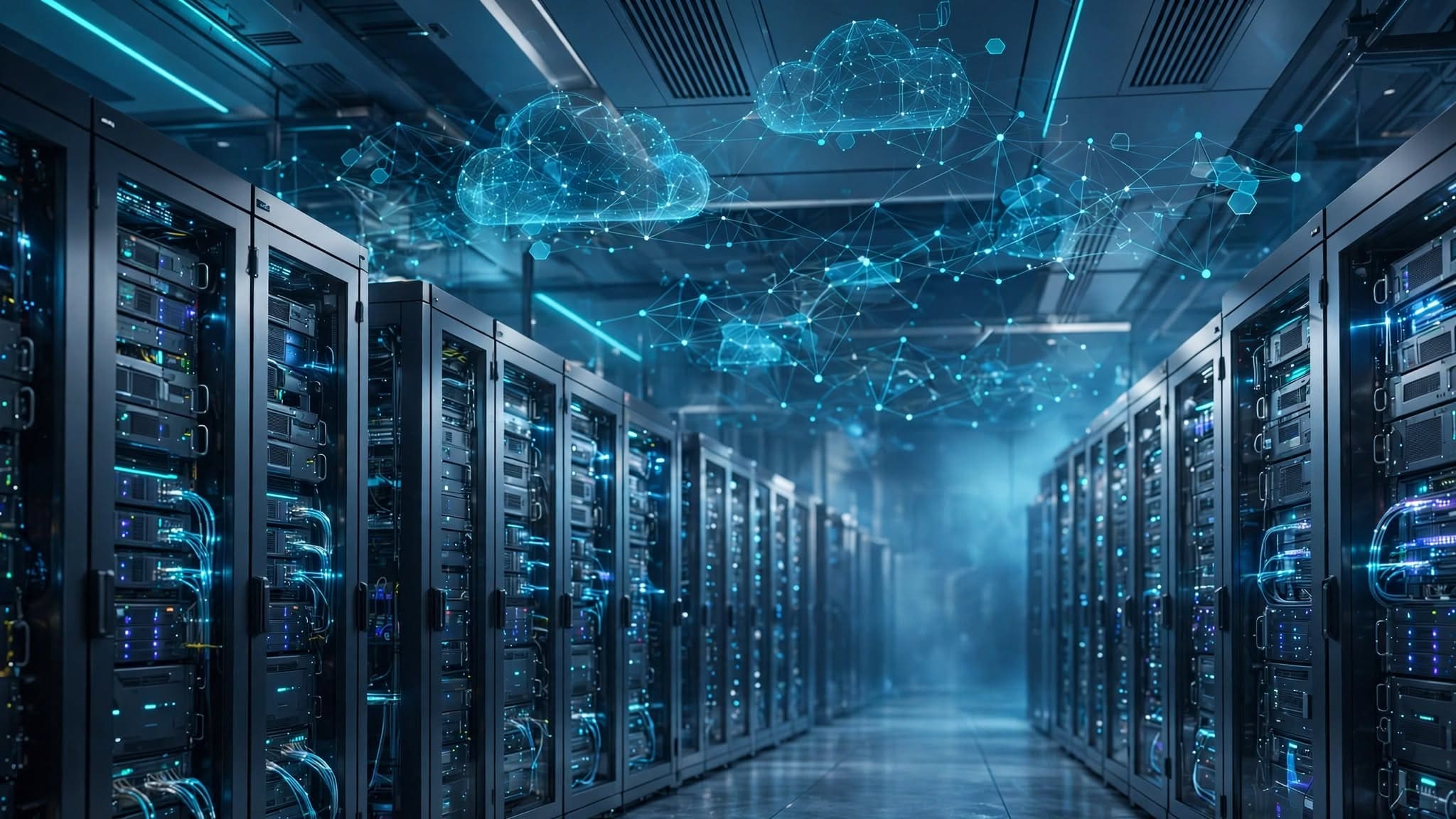

How AI Is Increasing Demand for Data Centers in 2026
Artificial intelligence is transforming the way businesses operate, deliver services, and interact with customers. The growth of AI is also driving a major transformation in the infrastructure behind modern digital services, creating rapidly increasing demand for the computing infrastructure required to power modern AI applications.
From generative AI and AI assistants to automated business systems, advanced analytics, and AI agents, these technologies require significant computing resources. As adoption continues to accelerate in 2026, technology companies, cloud providers, and businesses are investing in data-center infrastructure to meet growing demand.
Data centers provide the servers, storage, networking, power, and cooling systems that keep today's digital services running. As AI workloads become more sophisticated, these facilities are becoming an increasingly important part of the global technology ecosystem.
AI Is Driving Data Center Expansion
AI is now one of the key factors contributing to the expansion of data-center infrastructure. Training and operating advanced AI models requires powerful processors, particularly specialized chips designed for high-performance computing.
The International Energy Agency (IEA) reported that global data-center electricity consumption increased by 17% in 2025, while electricity consumption from AI-focused data centers increased by approximately 50%. The IEA also projects that global data-center electricity consumption could nearly double from around 485 TWh in 2025 to approximately 950 TWh by 2030.
These figures demonstrate how closely the continued development of AI is becoming linked to the availability of physical computing infrastructure.
Rising Demand for Power
One of the most significant challenges associated with AI infrastructure is the amount of electricity required to operate high-performance computing systems.
AI servers perform computationally intensive workloads, including model training, inference, and large-scale data processing. As more businesses adopt AI and existing applications become more sophisticated, the demand for computing capacity and consequently electricity is increasing.
Gartner estimates that global data-center electricity consumption will reach approximately 565 TWh in 2026, representing a 26% increase from 2025. Gartner also estimates that AI-optimized servers will account for approximately 31% of data-center power consumption during 2026.
As a result, access to reliable electricity is becoming an important consideration when developing new data centers. Operators are also placing greater emphasis on energy efficiency, power management, and sustainable infrastructure.
Investment in AI Infrastructure Is Accelerating
Growing demand for AI computing is encouraging technology companies and cloud providers to expand their infrastructure significantly.
Recent developments illustrate the scale of this investment. Microsoft was reported in September 2026 to be planning approximately 38 gigawatts of data-center capacity by 2032, representing a substantial expansion of its existing infrastructure, with AI workloads expected to be an important driver of demand.
NVIDIA has also announced collaborations in Australia focused on expanding the land, power, and data-center capacity required to support AI infrastructure. These developments highlight an important shift in the technology industry. AI growth is no longer solely about developing better models and software. It increasingly depends on the physical infrastructure capable of running those systems at scale.
Data Center Capacity Is Becoming More Limited
Although companies are investing heavily in new facilities, demand for data-center capacity is also increasing rapidly.
CBRE reported in September 2026 that demand continued to exceed available supply across several major North American data-center markets. In Northern Virginia, one of the world's largest data-center markets, vacancy fell to approximately 0.2% during the first half of 2026, despite continued construction.
CBRE also reported that more than 80% of capacity under construction had already been preleased. This demonstrates that expanding data-center capacity involves more than constructing new buildings. Developers also need suitable locations, reliable power supplies, high-speed connectivity, advanced cooling systems, and access to specialized computing hardware.
Cooling and Energy Efficiency Matter More
The increasing density and performance of AI computing systems are also changing how data centers are designed. High-performance AI hardware generates significant amounts of heat, making effective cooling essential for maintaining reliable operations. As computing workloads become more demanding, data-center operators are exploring advanced cooling technologies and more efficient approaches to power management.
Energy management is also becoming an important area of innovation. In September 2026, Google, NVIDIA, Anthropic, and other organizations launched an initiative focused on flexible AI data centers that can better coordinate computing workloads with electricity-grid conditions.
These developments reflect a broader industry effort to make AI infrastructure more efficient while meeting rapidly growing computing requirements.
What Does This Mean for Businesses?
The expansion of AI infrastructure will affect businesses of all sizes, not just major technology companies.
Organizations increasingly rely on cloud platforms, AI software, automation tools, and data-driven applications. The availability of reliable AI infrastructure can enable businesses to access more advanced services without having to build their own large-scale computing facilities. For businesses, this can create opportunities for faster automation, improved data analysis, enhanced customer experiences, and the adoption of new AI-powered services.
At the same time, organizations should consider factors such as cloud costs, data security, infrastructure reliability, scalability, and the capabilities of their technology providers when expanding their use of AI.
What to Expect in the Coming Years
The relationship between AI and data-center infrastructure is expected to become even stronger as new AI applications emerge.
AI agents, advanced reasoning systems, video generation, and other compute-intensive applications can require significantly more computing resources than simpler AI workloads. The IEA notes that some emerging AI applications can require substantially more energy than basic text-generation tasks.
This means the next phase of AI development will depend on more than software innovation. It will also require scalable computing infrastructure, reliable electricity, efficient cooling, high-speed networking, and increasingly sophisticated data centers.
Conclusion
AI is driving rapid growth in data-center investment in 2026, increasing demand for computing power, energy, cooling, and advanced infrastructure. As AI adoption continues to expand, modern data centers will play a critical role in supporting the future of AI-powered businesses and digital services.