

Digital Twins in 2027: How Virtual Replicas Will Transform Business Operations
Last Updated: October 2026
Businesses are increasingly exploring digital technologies to improve efficiency, reduce operational costs, and make better decisions. One technology attracting attention is the digital twin, which is a virtual representation of a physical asset, system, process, or facility that uses real-world data to reflect its condition and behavior. Looking ahead to 2027, digital twins could play an increasingly valuable role in business operations by combining real-time data, simulation, and artificial intelligence (AI) to help organizations monitor performance, anticipate potential problems, and evaluate improvements before implementing them in the real world.
What Is a Digital Twin?
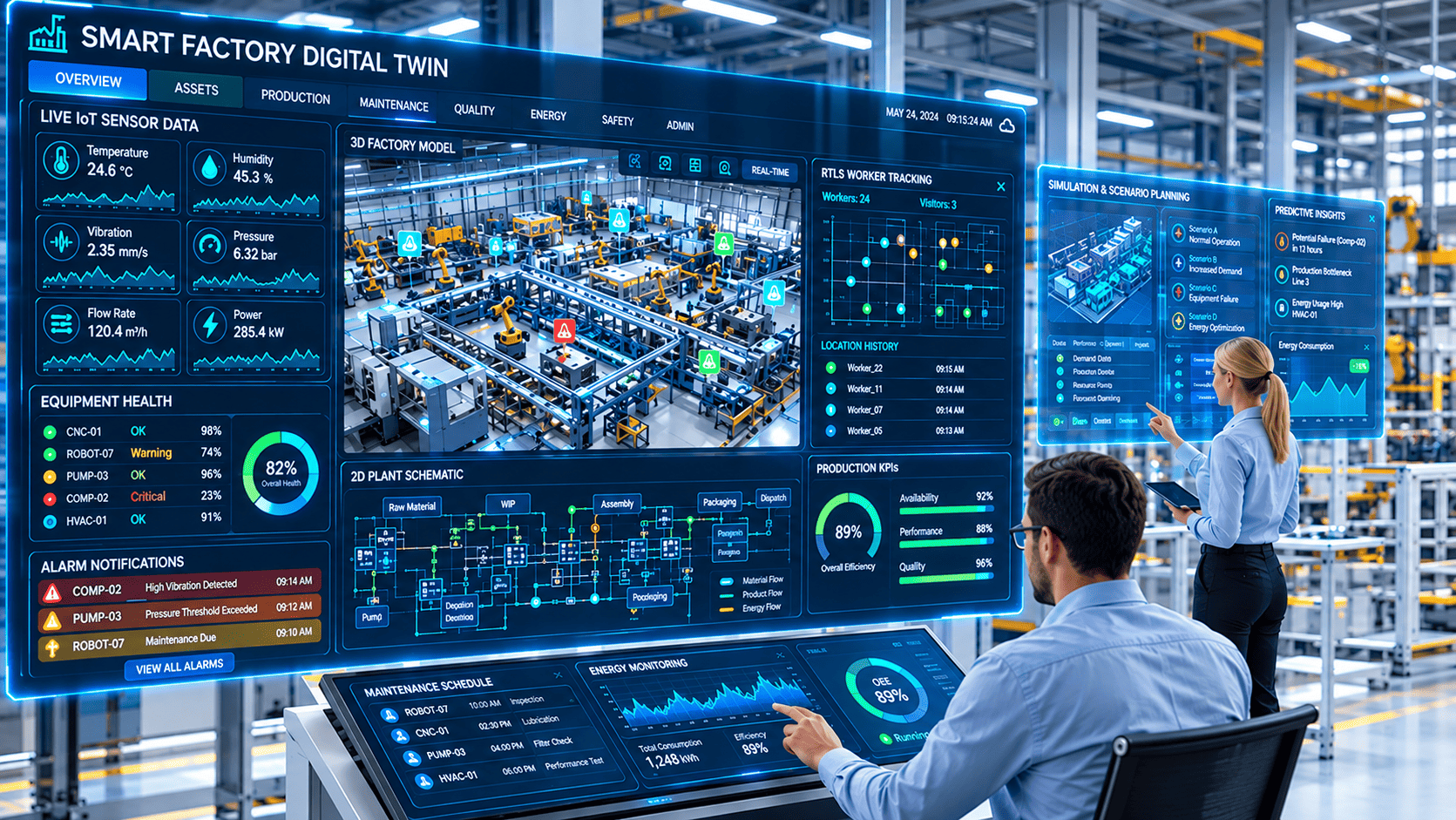
A digital twin is a virtual representation of a physical asset, system, or process that uses relevant data to reflect real-world conditions and behavior. It may combine sensors, Internet of Things (IoT) devices, artificial intelligence (AI), and simulation tools to support monitoring, analysis, and prediction. Unlike a static 3D model, a digital twin can be updated with operational data at a frequency appropriate to its purpose. Depending on its design, it can help organizations evaluate performance, explore possible scenarios, and anticipate potential problems. For example, a manufacturer can use a digital twin of a production machine to analyze temperature, energy consumption, and performance data, helping maintenance teams identify unusual patterns and plan inspections before a serious breakdown occurs.
How Digital Twins Will Transform Business Operations in 2027
1. Smarter Manufacturing and Predictive Maintenance
Manufacturing is one of the most promising applications of digital twin technology. Companies can create virtual models of machinery, production lines, and entire facilities to understand how equipment performs under different conditions.
Digital twins can help maintenance teams identify early warning signs, investigate production bottlenecks, and plan repairs more effectively. This approach can reduce unexpected downtime and improve equipment utilization when supported by reliable data and appropriate maintenance processes. In 2027, businesses may increasingly combine digital twins with AI-powered analytics to improve production planning and operational visibility.
2. More Efficient Supply Chains
Supply chains involve multiple suppliers, warehouses, transportation networks, and distribution centers. Disruptions in one area can affect the entire operation.
A digital twin of a supply chain can bring together information about inventory, transportation, demand, and delivery schedules. Businesses can use simulations to explore potential disruptions, compare logistics strategies, and evaluate how changes in demand could affect inventory levels. This helps decision-makers prepare for different scenarios instead of relying entirely on historical reports or reacting after problems occur.
3. Energy Management and Sustainable Operations
Rising energy costs and sustainability goals are encouraging organizations to monitor how their facilities consume resources.
Digital twins of buildings and industrial facilities can combine information about energy usage, equipment performance, occupancy, and environmental conditions. Organizations can then identify inefficiencies and evaluate possible improvements. For example, a company could simulate different heating, cooling, or equipment schedules to understand their potential impact on energy consumption. The resulting insights can support cost reduction and more sustainable operations.
4. Better Product Design and Testing
Digital twins can support product development by allowing engineers to simulate how products may perform under different operating conditions. Before building multiple physical prototypes, teams can test selected designs virtually, identify potential weaknesses, and explore improvements. This can be especially valuable in industries where physical testing is expensive or complex. However, simulation results depend on the quality of the underlying models and data. Physical testing and validation remain important for confirming product safety and performance.
5. Improved Business Decision-Making
Digital twins can provide managers with a clearer view of operational performance by connecting data from different systems. Instead of reviewing disconnected reports, decision-makers can use virtual models to investigate problems, compare possible solutions, and understand the potential consequences of operational changes. When combined with AI and advanced analytics, digital twins can help identify patterns and support forecasting. Human expertise remains essential for interpreting results and making decisions that involve financial, safety, or strategic risks.
Emerging Digital Twin Trends to Watch in 2027
Digital twin technology may become more capable as businesses integrate it with artificial intelligence, real-time data systems, and advanced simulation tools.
AI-Powered Simulation: AI can help analyze operational data, identify unusual patterns, and evaluate possible scenarios to improve maintenance planning and operational efficiency.
Real-Time Data Integration: Sensors and Industrial Internet of Things (IIoT) systems can help digital twins reflect changing conditions in machinery, buildings, and production environments.
Connected Digital Twins: Businesses may explore connecting digital twins across equipment, facilities, and workflows to understand how changes in one area affect other operations.
Security and Reliability: As digital twins become more connected, organizations will need to prioritize cybersecurity, data quality, interoperability, and model validation.
The practical value of these developments will depend on each organization's objectives, technical capabilities, data quality, and implementation costs.
Challenges Businesses Should Consider
Despite their potential, digital twins are not suitable for every organization or every process. Implementation may require significant investment in sensors, software, data integration, infrastructure, and specialized skills. Poor-quality data can produce misleading simulations, while incompatible systems can make integration difficult. Businesses must also consider cybersecurity, access controls, data privacy, and the ongoing cost of maintaining accurate models.
A practical approach is to begin with a clearly defined business problem, such as reducing machine downtime or improving energy efficiency. Companies can then test a limited pilot project, measure its results, and expand gradually if the benefits justify the investment.
Businesses should also establish clear procedures for validating digital twin models, managing data quality, and ensuring that systems from different vendors can exchange information reliably.
Conclusion
Digital twins could transform business operations in 2027 by improving efficiency, supporting smarter decisions, and optimizing manufacturing, supply chains, and energy management. Their success will depend on reliable data, clear business objectives, strong cybersecurity, and effective integration with existing systems.